AI Agents & Autonomous AI : AI The Next Frontier in AI
AI Agents & Autonomous AI : AI The Next Frontier in AI(2026)
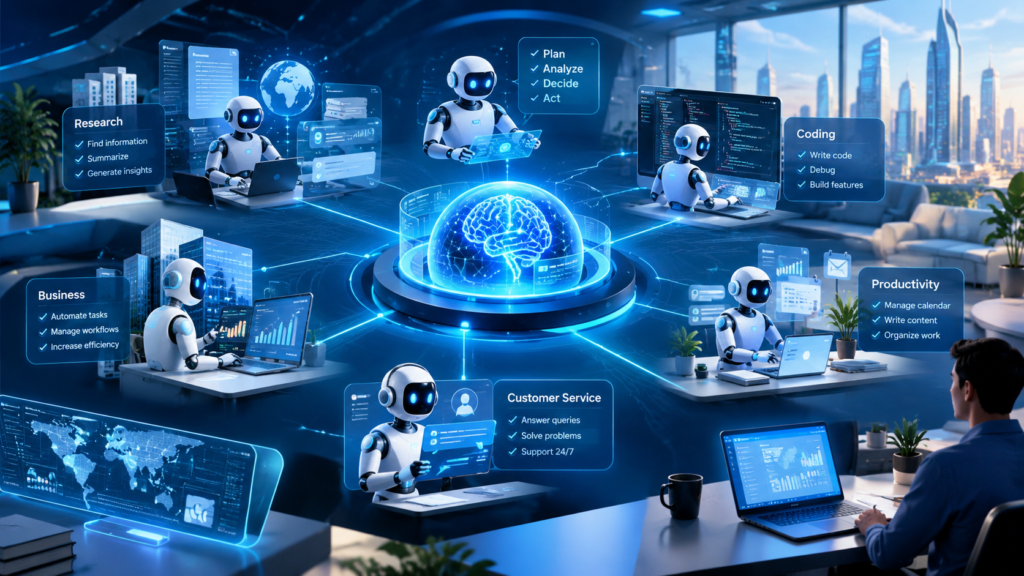
Future of artificial intelligence AI agent technology
Artificial intelligence has taken the world by storm over the past few years. From the initial hype around ChatGPT in 2023 to the current wave of powerful models in 2026, generative AI has already transformed how we work, learn, and create. However, the next major leap is not just about generating text or images anymore. It is about building systems that can act – systems that think, plan, use tools, and complete complex tasks with minimal human intervention. These systems are called AI Agents and Autonomous AI.
In this comprehensive guide, we will explore what AI agents are, how they differ from traditional generative AI, the leading tools and frameworks available in 2026, real-world use cases, technical architecture, challenges, and the exciting future that lies ahead. Whether you are a business owner, developer, student, or simply curious about technology, this article will give you a clear understanding of this rapidly evolving field.
What Exactly Is an AI Agent?
An AI agent is an intelligent software system designed to achieve specific goals with a high degree of autonomy. Unlike traditional chatbots or generative models that respond to individual prompts, an AI agent can break down a complex objective into smaller steps, select and use appropriate tools, monitor its own progress, and adjust its strategy when things do not go according to plan.
Think of it this way:
- A normal generative AI model (like ChatGPT or Claude) is like a highly skilled assistant you must guide at every step.
- An AI agent is like a competent employee who receives a high-level goal, creates a plan, gathers the necessary resources, executes the plan, and delivers the finished product while keeping you informed of major milestones.
Key characteristics of modern AI agents include:
- Goal-oriented behavior: They work toward a clearly defined objective.
- Planning capability: They can create multi-step plans.
- Tool usage: They can interact with external tools such as web browsers, APIs, email clients, databases, and even computer interfaces.
- Memory and learning: They maintain short-term and long-term memory to improve future performance.
- Error recovery: They can detect mistakes and try alternative approaches.
- Autonomy: They operate with minimal ongoing human supervision.
Autonomous AI vs Traditional Generative AI
To understand the significance of AI agents, it is essential to compare them with the generative AI models most people are familiar with.
| Feature | Traditional Generative AI | Autonomous AI Agents |
|---|---|---|
| Input required | Frequent prompts needed | Single high-level goal is usually sufficient |
| Planning | Limited or none | Multi-step planning and reasoning |
| Tool integration | Manual or none | Automatic tool selection and use |
| Error handling | User must correct mistakes | Self-correction and alternative strategies |
| Task completion | Provides partial answers | Aims for end-to-end task completion |
| Examples (2026) | ChatGPT, Claude, Gemini, Llama | OpenAI Swarm, CrewAI, LangGraph, Auto-GPT |
Traditional generative AI excels at creating content, answering questions, and assisting with creative work. However, it still requires constant human direction. Autonomous AI agents take the next step by turning that assistance into actual execution.AI Agents and Autonomous AI
The Rise of AI Agents in 2026
By 2026, AI agents have moved from experimental projects to practical tools used by both individuals and large organizations. Several factors have accelerated this growth:
- Improved reasoning capabilities of large language models.
- Better tool-calling and function-calling features in modern LLMs.
- Development of dedicated agent frameworks such as CrewAI, LangGraph, and OpenAI’s Swarm.
- Falling costs of API calls, making long-running agent tasks more affordable.
- Increased enterprise interest in automating repetitive and knowledge-based work.
The market for AI agents is projected to grow rapidly over the next five years. Companies are no longer asking “Should we use AI?” but rather “How can we deploy AI agents to gain a competitive advantage?”
Leading AI Agent Frameworks and Tools in 2026
Here are some of the most prominent and widely used AI agent solutions available today:
Enterprise and Commercial Solutions
- OpenAI Swarm: A lightweight, multi-agent orchestration framework released by OpenAI. It allows developers to create teams of agents that collaborate on complex tasks.
- Anthropic Computer Use: Claude’s ability to control a computer screen, click buttons, and interact with software applications.
- Adept AI: Focuses on action models that can perform tasks on behalf of users in digital environments.
- MultiOn: Specializes in browser-based automation and web tasks.
- Browserbase: Provides reliable browser infrastructure for agent-based web interactions.
Open-Source and Developer-Friendly Frameworks
- CrewAI: One of the most popular frameworks for building role-based agent teams (e.g., Researcher, Writer, Analyst).
- LangGraph: Built on top of LangChain, it offers powerful stateful agent workflows and human-in-the-loop capabilities.
- Auto-GPT: The original open-source autonomous agent that started the modern agent movement.
- BabyAGI: A simpler, task-driven autonomous agent framework.
- MetaGPT: Uses a software company simulation approach with different agent roles.
Regional and Emerging Players
- Krutrim (India): Developing India-specific models with growing agent capabilities.
- Sarvam AI (India): Building foundational models and agent infrastructure tailored for Indian languages and use cases.
These frameworks vary in complexity, cost, and ease of use. Beginners often start with CrewAI or LangGraph because of their excellent documentation and active communities.
Real-World Use Cases
AI agents are already delivering value across multiple industries and personal scenarios. Here are some of the most impactful examples:
Personal Productivity
- Managing daily schedules, booking appointments, and handling email.
- Conducting in-depth research and summarizing findings into reports.
- Tracking personal finances, analyzing investments, and generating monthly reports.
- Planning travel itineraries with real-time price monitoring.
Business and Enterprise
- 24/7 customer support agents that can handle complex queries and escalate only when necessary.
- Sales lead qualification and initial outreach automation.
- Content creation pipelines (research → draft → edit → publish).
- Automated data entry, report generation, and compliance checks.
- Supply chain monitoring and predictive maintenance alerts.
Industry-Specific Applications
- Healthcare: Assisting with patient scheduling, insurance verification, and preliminary symptom checking.
- Education: Personalized tutoring agents that adapt to individual learning styles.
- E-commerce: Product listing optimization, customer query handling, and inventory management.
- Finance: Market research, portfolio rebalancing suggestions, and fraud detection monitoring.
- Agriculture (especially relevant for India): Weather-based advisory, market price tracking, and crop management recommendations.
How Do AI Agents Work? Technical Architecture
Understanding the internal workings of an AI agent helps demystify the technology. A typical modern AI agent follows a cyclical process with several core components:
- Perception Layer
The agent gathers information from its environment. This can include reading text, viewing screen content, accessing databases, or monitoring APIs. - Reasoning and Planning Layer
Powered by a large language model, this layer breaks down the goal into sub-tasks, creates a plan, and decides which tools to use at each step. - Tool Use / Action Layer
The agent calls external tools such as web search, email APIs, browser automation, code interpreters, or even computer control interfaces. - Memory System
Short-term memory holds the current task context, while long-term memory stores past experiences and learned patterns. - Execution and Feedback Loop
After taking an action, the agent observes the result, evaluates progress toward the goal, and decides whether to continue, adjust, or stop. - Human-in-the-Loop (Optional)
Many production systems allow humans to review critical decisions or intervene when the agent encounters uncertainty.
This loop continues until the original goal is achieved or the agent determines that it cannot proceed without further input.
Challenges and Limitations
Despite the impressive progress, AI agents still face several significant challenges in 2026:
- Reliability and Consistency
Agents can still hallucinate, get stuck in loops, or make incorrect decisions that require human correction. - Cost
Long-running agent tasks can consume many API tokens, making them expensive for certain use cases. - Security and Privacy
Giving an agent access to email, banking apps, or sensitive data raises serious security concerns. - Ethical and Regulatory Issues
Questions around accountability, bias, and the potential for misuse are still being debated by governments and organizations worldwide. - Technical Complexity
Building robust, production-grade agent systems requires expertise in prompt engineering, tool integration, and workflow design.
These limitations are being actively addressed by researchers and companies, and the technology is improving rapidly.
The Future of AI Agents (2027–2030)
Looking ahead, the evolution of AI agents is expected to be dramatic:
- AI Employee Teams
Instead of a single agent, organizations will deploy teams of specialized agents (e.g., a CEO agent, marketing agent, developer agent, and finance agent) that collaborate. - Personal AI Operating Systems
Every individual will have a personal suite of agents that manage their digital life, from finances to health to career development. - Integration with Physical World
Agents will increasingly control robots and IoT devices, bridging the digital and physical realms. - Stronger Regulation
Governments will introduce clearer rules around autonomous systems, transparency requirements, and liability. - New Job Categories
Roles such as “Agent Trainer,” “Agent Auditor,” and “Multi-Agent System Designer” will emerge as the ecosystem matures.
By 2030, it is likely that autonomous AI agents will be as common in the workplace as email is today.
Conclusion
AI agents represent the natural next step in the evolution of artificial intelligence-from tools that assist humans to systems that can act independently toward defined goals. In 2026, the technology has reached a level of maturity where both individuals and organizations can start experimenting with real value-creating applications.
The organizations and individuals who begin learning and deploying AI agents now will be best positioned to capitalize on the opportunities of the coming decade. Whether you are looking to boost personal productivity, automate business processes, or build the next generation of intelligent applications, AI agents offer a powerful new paradigm.
The future is not just about asking AI questions. It is about giving AI goals and letting it get to work.
FAQs
Q1. What is the difference between an AI agent and ChatGPT?
ChatGPT is a generative model that responds to prompts. An AI agent is a goal-oriented system that plans, uses tools, and completes tasks with far greater autonomy.
Q2. Can non-technical users start using AI agents today?
Yes. Platforms like CrewAI and several no-code agent builders have made the technology accessible even for beginners.
Q3. Are AI agents safe to use with sensitive data?
Safety depends on the implementation. Always use trusted frameworks, limit permissions, and follow best practices for data security.
Q4. Will AI agents replace human jobs?
Some routine and knowledge-based jobs will be automated, but new roles in agent management, oversight, and design will be created.
Q5. What is the best way to get started with AI agents?
Start with a simple framework like CrewAI, follow official tutorials, and begin with low-stakes personal productivity tasks before moving to business-critical applications.
Future of artificial intelligence AI agent technology
Why You Overeat: Understanding the 11 Real Reasons Behind Eating More Than You Need
25 Best Free AI Tools Online You Can Use in 2026
https://youtube.com/@our_black_world?si=4lNGPIFirRkux6z8




This is really helpful 🙂
thanks for your response. this is give me a lot of motivation …