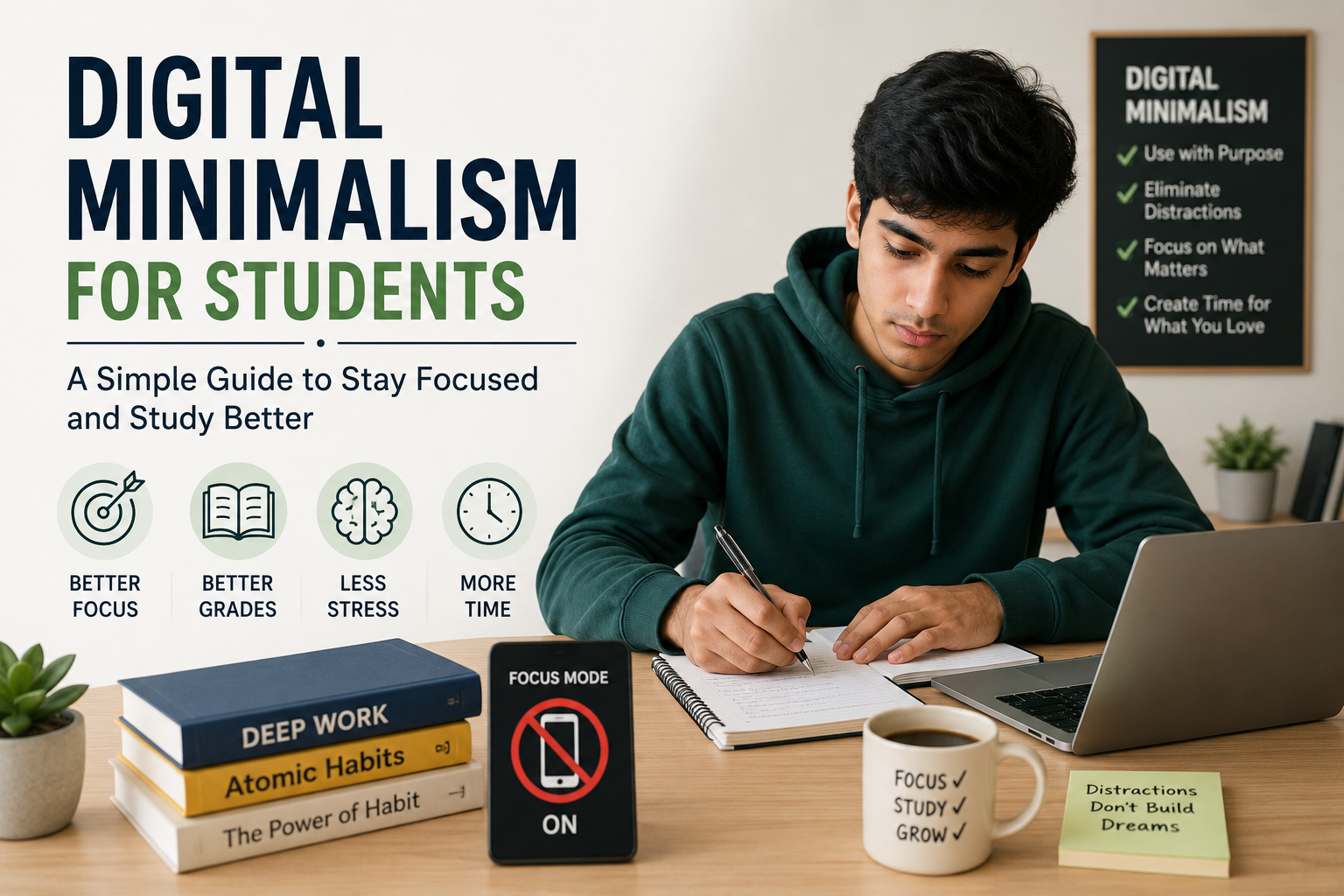
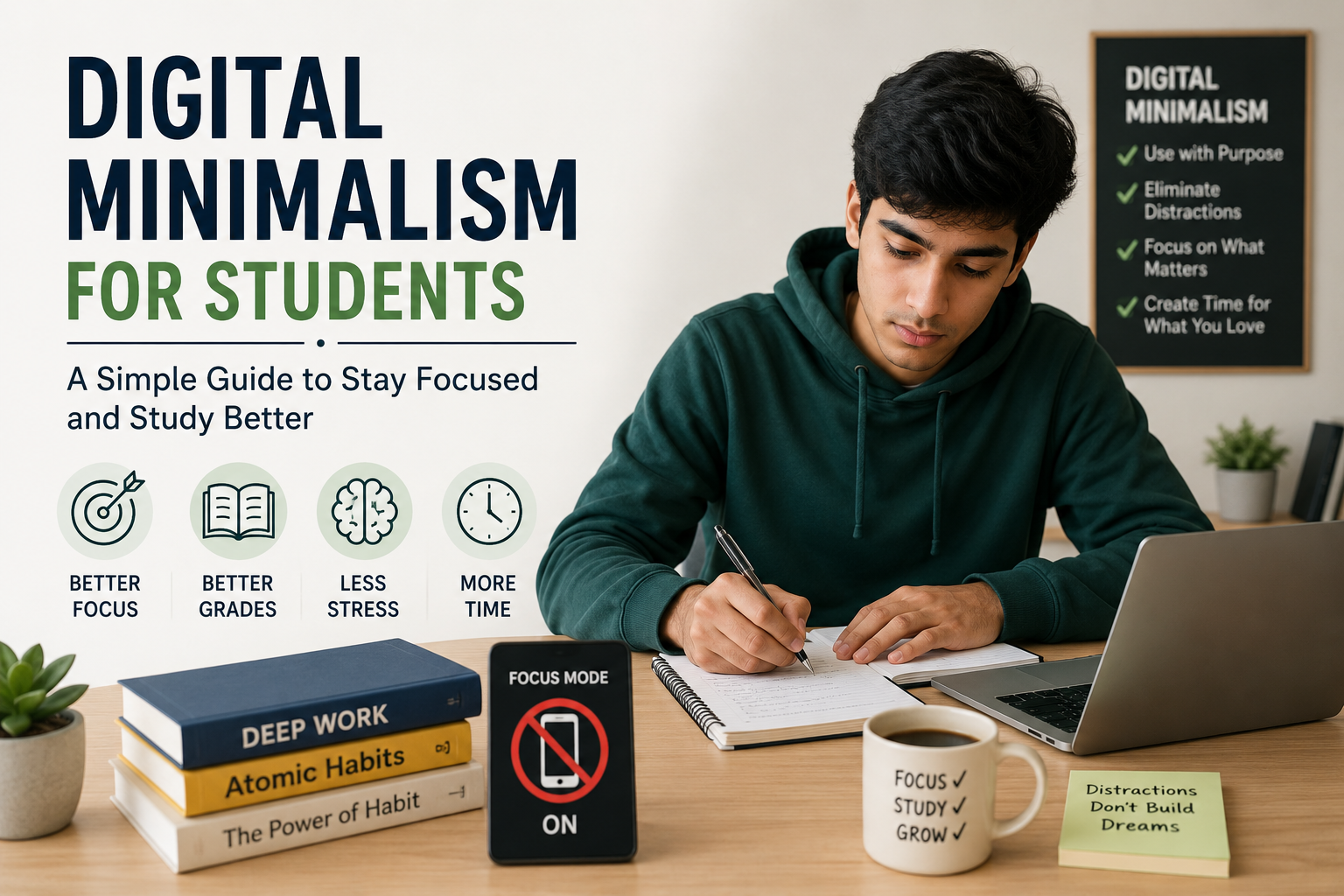
Digital Minimalism for Students: A Simple Guide to Stay Focused and Study Better

Digital Minimalism for Students: A Simple Guide to Stay Focused and Study Better
Introduction
In today’s hyper -connected world, students spend hours switching between online classes, social media, messaging apps, and entertainment platforms. While technology makes learning easier, it can also become one of the biggest obstacles to productivity and mental well-being.
If you often find yourself checking your phone during study sessions or losing track of time while scrolling through social media, digital minimalism can help. This simple philosophy encourages intentional technology use so you can focus on what truly matters. .
In this beginner’s guide, you’ll learn what digital minimalism is, why it matters for students, and practical strategies to improve focus, earn better grades, and reduce stress..
Learn about Micro habits click now. >>>>Micro Habits ? : The 2-Minute Rule for Self-Improvement
Micro Habits ? : The 2-Minute Rule for Self-Improvement
What Is Digital Minimalism?
Digital minimalism is the practice of using technology with purpose rather than by habit. Instead of allowing notifications, endless feeds, and unnecessary apps to consume your attention, you consciously choose digital tools that support your goals and eliminate those that do not.
For students, this means using technology to enhance learning instead of letting it become a distraction.
Why Digital Minimalism Matters for Students
The average student is constantly surrounded by digital distractions. Every notification, message, or video recommendation interrupts concentration and makes it harder to return to deep study.
Practicing digital minimalism offers several benefits:
- Improved concentration during study sessions
- Better time management and productivity
- Higher academic performance
- Reduced stress and mental fatigue
- Improved sleep quality
- More time for exercise, hobbies, and relationships
- Greater sense of control over daily routines
Learn about >>>>Dopamine Detox ?
7 Practical Steps to Practice Digital Minimalism
1. Audit Your Screen Time
Most smartphones provide weekly reports showing how much time you spend on different apps. Review these reports honestly and identify where your attention goes each day.
Awareness creates accountability.
2. Remove Unnecessary Apps
Delete apps you rarely use or that encourage mindless scrolling. You can always reinstall them if you genuinely need them later.
A cleaner phone often leads to a clearer mind.
3. Turn Off Non-Essential Notifications
Notifications constantly interrupt concentration. Disable alerts from social media, shopping apps, games, and promotional services while keeping only essential communication and academic reminders enabled.
4. Create Dedicated Study Sessions
When studying:
- Put your phone out of reach.
- Enable Do Not Disturb mode.
- Close unrelated browser tabs.
- Focus on one task at a time.
Short, distraction-free sessions are often more productive than hours of interrupted studying.
5. Organize Your Digital Workspace
Keep your laptop and phone organized by:
- Removing unnecessary files
- Creating folders for class materials
- Cleaning your desktop
- Bookmarking important study resources
6. Schedule Social Media Time
Instead of checking apps throughout the day, designate specific times to use them.
For example:
- 20 minutes after lunch
- 30 minutes after completing homework
This prevents constant interruptions while still allowing enjoyable breaks.
7. Replace Scrolling with Healthy Activities
Every hour saved from unnecessary screen time can be invested in activities such as:
- Reading books
- Exercising
- Journaling
- Learning a new skill
- Spending time outdoors
- Talking with family and friends
A Simple 7-Day Digital Minimalism Challenge
Day 1 : Check your daily screen time.
Day 2 : Disable non-essential notifications.
Day 3 : Delete five unnecessary apps.
Day 4 : Avoid screens for the first 30 minutes after waking up.
Day 5 : Complete one study session without your phone nearby.
Day 6 : Spend one hour on an offline activity.
Day 7 : Reflect on the changes and decide which habits to keep permanently.
Common Mistakes to Avoid
Many beginners struggle because they try to eliminate technology completely.
Instead, avoid these common pitfalls:
- Expecting instant results
- Deleting useful educational apps
- Replacing one distraction with another
- Using social media during study breaks
- Feeling guilty about occasional entertainment
Digital minimalism is about balance, not perfection.
Frequently Asked Questions
i . Do I need to delete all social media accounts?
No. The objective is intentional use, not complete avoidance. Keep platforms that add value and limit those that waste time.
ii . Will digital minimalism improve my grades?
Reducing distractions can help you study more effectively, complete assignments faster, and maintain better concentration, all of which may contribute to improved academic performance.
iii . How long does it take to build better digital habits?
Many students notice positive changes within a few weeks of consistently limiting distractions and following structured routines.
Final Thoughts
Technology is a powerful tool, but only when used intentionally. Digital minimalism helps students reclaim their attention, reduce unnecessary stress, and focus on what truly matters- learning, personal growth, and meaningful experiences.
You don’t need to quit using your phone or laptop. Simply make conscious choices about when and how you use them. Small daily changes can lead to better focus, healthier habits, improved grades, and a more balanced life.
Start today by removing one distraction, creating one focused study session, or spending one hour offline. Those small actions can become the foundation for lasting success.
Source links:
🌍 World Health Organization (WHO) – Digital Health:
https://www.who.int/health-topics/digital-health
Digital Minimalism (Cal Newport – Official Book Page):
https://www.calnewport.com/books/digital-minimalism/
American Psychological Association (APA) – Technology & Mental Health:
https://www.apa.org/topics/technology
Mayo Clinic – Healthy Lifestyle & Sleep Resources:
https://www.mayoclinic.org/healthy-lifestyle
Harvard Health Publishing – Mind & Mood:
https://www.health.harvard.edu/topics/mind-and-mood
Digital Minimalism for Students: A Simple Guide to Stay Focused and Study Better